On Vermicomposting
I started vermicomposting around 9 months ago or so. My sense of time is horrible ever since the COVID pandemic happened. Is this common? 2020 to 2026 went by in the blink of an eye, seriously.
Anyway, vermicomposting is the process of composting with “vermi”. Vermis is the Latin word for “worm”. It follows that vermicomposting is the process of obtaining vermicompost using worms. It is also called worm humus. This end-product is nutrient-rich (if you are a plant) and can improve soil structure, water retention and biological activity. Interestingly, its effects on plant growth aren’t explained simply by adding more nutrients. Vermicompost appears to contain other compounds and biological effects that can influence plant growth.12
Vermicompost is, again, in very crude terms, worm poop. More precisely, it is the product of the biological decomposition and transformation of organic matter involving worms and a whole community of microorganisms. In the following picture, you can see little white things. These are springtails. They’re tiny arthropods that are common in moist organic environments. Many species feed on fungi, bacteria and decaying organic matter, and they form part of the little ecosystem living inside the bin. Seeing too many of them tells me that my bin might be too wet though.
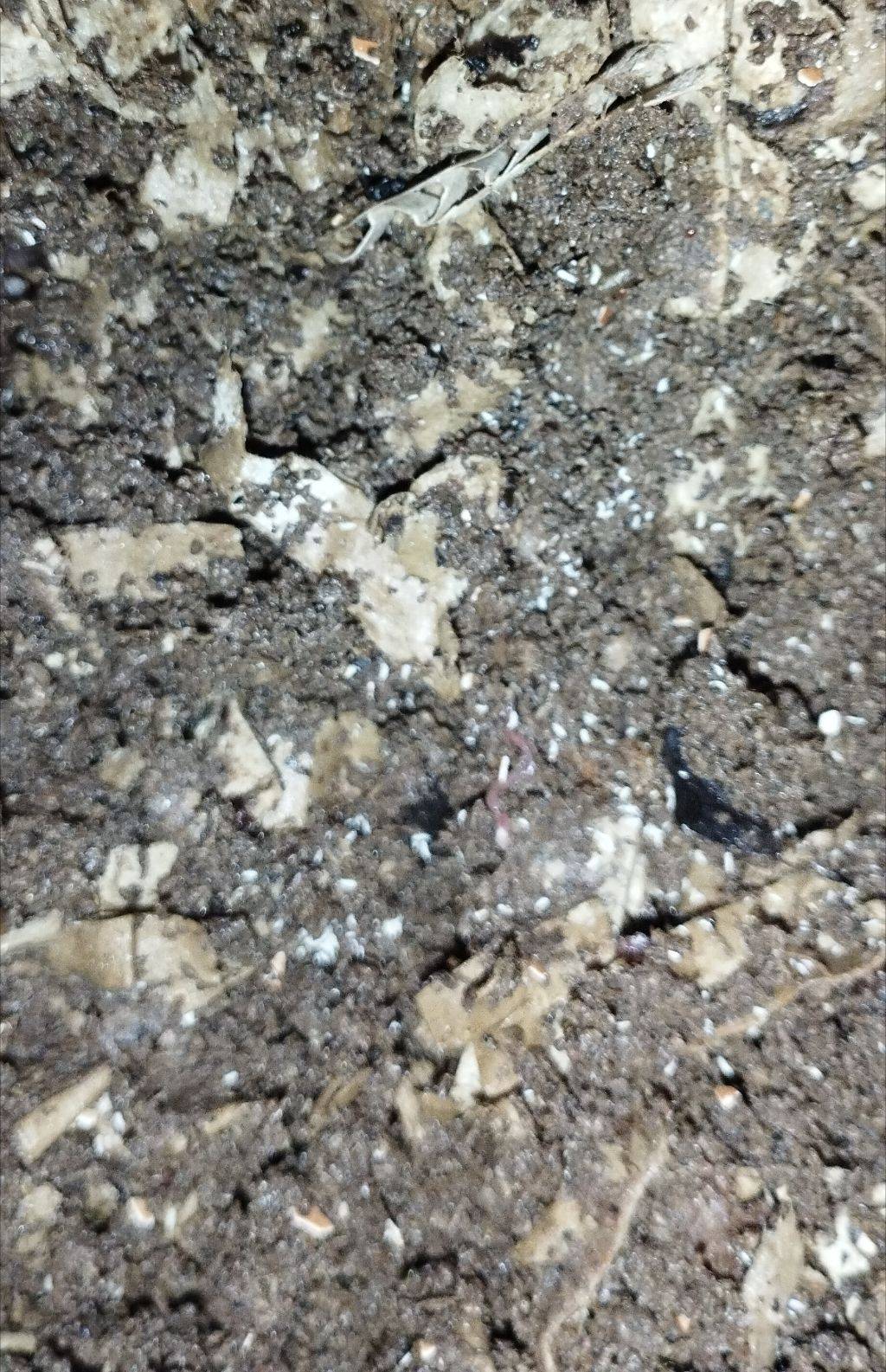
One can also see two additional things in this picture. One can see what many people would characterize as “soil” or “wet dirt”. That is the vermicompost. And there are also pieces of cardboard box. All that you see in this picture started as organic matter, worms and cardboard. I did not add any soil.
Another reason to vermicompost is that it reduces food and organic waste. I no longer throw organic waste (banana peels, old bananas, other fruit, vegetable scraps, etc) out now. I just place it in my worm bin and let the worms have a feast. I do this with coffee grounds as well as some egg shells. By doing this, you are diverting from landfills. This is important due to the fact that in landfills, the organic matter breaks down anaerobically (without oxygen). One of the main products of that is methane, (CH₄). Methane is a powerful greenhouse gas, much more potent than CO₂. A well-managed vermicomposting system is predominantly aerobic, so it does not produce methane as the principal end-product in the way an anaerobic landfill does. This is one reason why composting organic waste is generally preferable to sending it to a landfill. It is important to mention, however, that preventing food waste in the first place is still preferable to composting it.3
Another advantage is a social one. When one asks me if I have pets, and how many, I always tell them “yes, I have hundreds of pets!”. I initially bought 500 worms but, by now, they have reproduced and I must have many more. I haven’t counted though.
Contrary to popular belief, the vermicompost bin does not smell badly. It smells “earthy”, “soily”, but not bad. It is a pleasant smell actually.
My setup is extremely beginner friendly. It is a 75 L plastic box with shredded cardboard, worms, organic waste and water. I use a spray bottle to spray water and I cut every cardboard box that I receive from online shopping and feed them to my worms. So, the worms don’t just eat my organic waste. They also process a surprising amount of the cardboard that I get. I cut it, wet it and put it in the bin. The cycle is tree - cardboard box - worm food - vermicompost - soil.
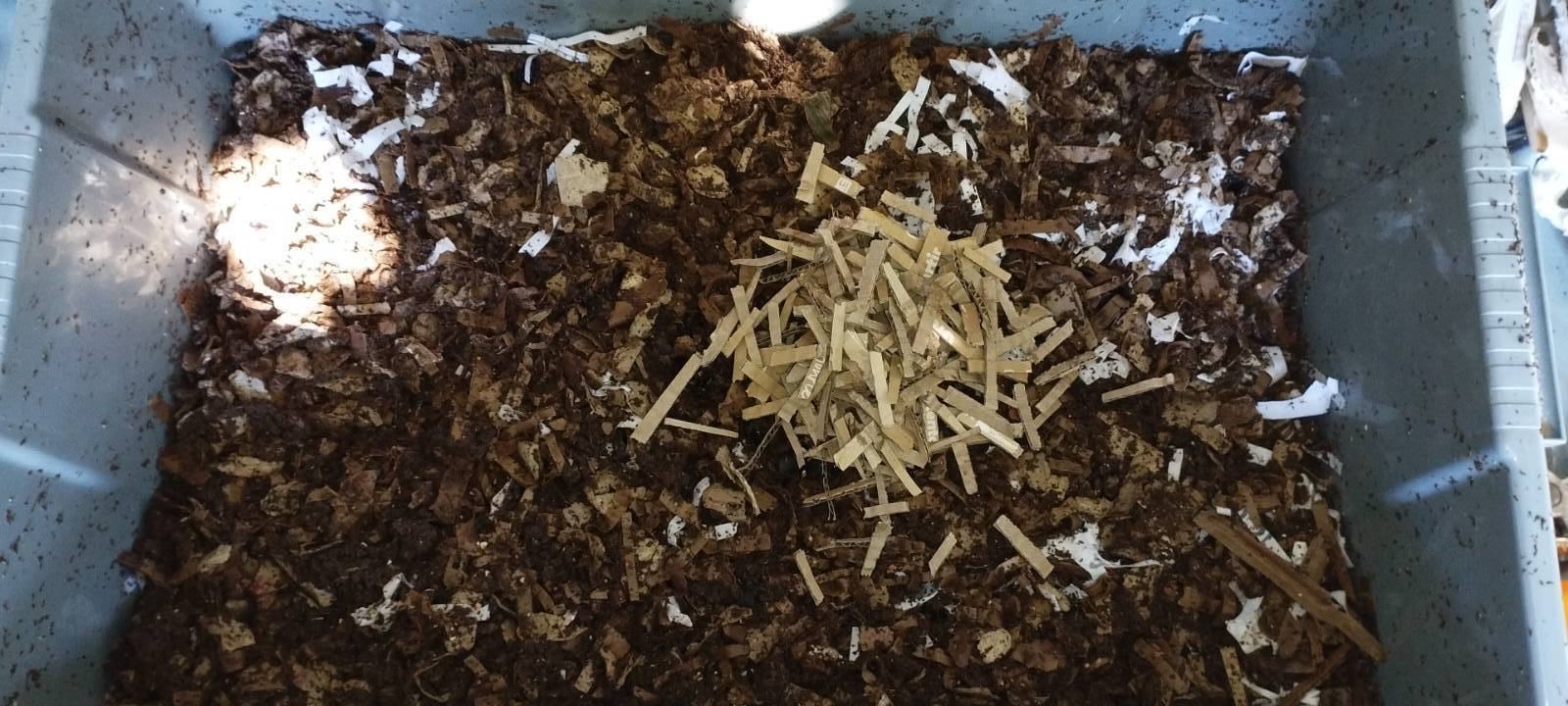
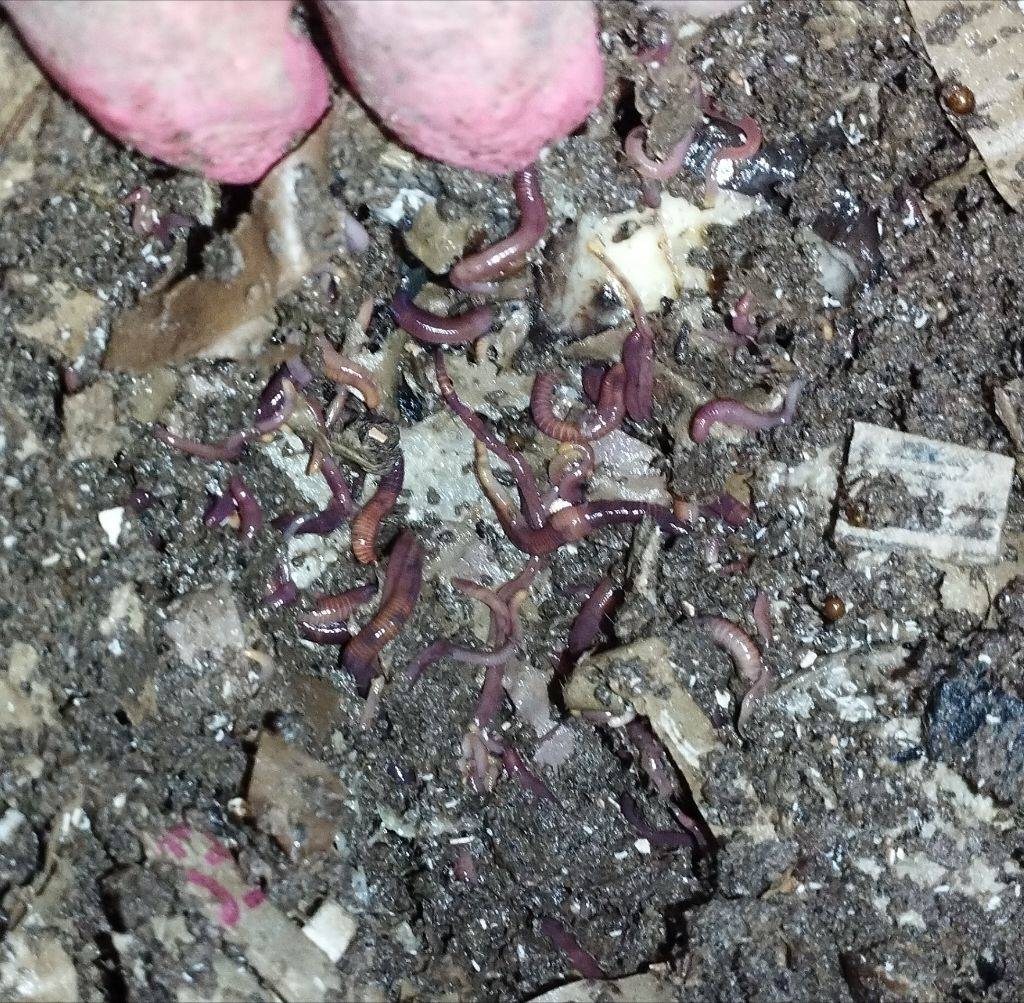
The worms themselves are the MVP. They are called Eisenia fetida, also known as californian worms. They are awesome for 5 reasons:
- They consume large amounts of decomposing organic material relative to their size;
- Rapid reproduction;
- Handle a large range of temperatures;
- They thrive in organic waste;
- They are extremely cute;
They’re not really the same sort of earthworm you find digging around in your garden. They’re epigeic worms, meaning they naturally live in the surface layers of decomposing organic material. In other words, I didn’t force a normal earthworm into a plastic box and force it to eat my organic matter. I chose a species whose natural lifestyle is basically to live in rotting vegetation and eat everything. 4
One thing I didn’t appreciate when I started is that the worms are not working alone. My worm bin is an ecosystem. Bacteria and fungi are doing a huge amount of the decomposition, and the worms interact with this microbial community as they eat, digest and move through the material. In other words, I have a bit more than a bin of worms. I have a tiny biological processing plant with tons of symbiotic relationships and other interactions. It is awesome!
The worms do do something though, they don’t just sit there waiting for bacteria to do all the work. As they feed, they physically break up organic material, pass it through their digestive systems and produce casts. This changes the physical and chemical characteristics of the material and also affects the microbial community living in the bin. 5
You can see in the next picture some worms congregating around an old banana.
Since it does not smell, is extremely easy to keep, and occupies very little space, this is something everyone could start doing, even those who live in an apartment. It is an extremely gratifying hobby. It is one of those things that I will never stop doing.
Some additional info
- Potato peels are really hard and take forever to decompose. I don’t vermicompost those yet. I throw them out, though I need to find an alternative. Maybe hot composting? Or perhaps I could shred them and add them to the vermicompost that way. The increase in surface area would surely help.
- Egg shells can take years to decompose. They are still beneficial though, as they provide calcium which is crucial for plant and worm health and, on top of that, they have also provide grit for worms. Worms do not have teeth, instead, they have a muscular organ called the gizzard whose goal is to mechanically break down swallowed organic matter. The gizzard lengthens and contracts and that movement is what breaks down the material. The presence of hard particles, such as egg shells, acts as grit which helps with the mechanical break down of organic matter.
- My bin does not have holes at the bottom. Most vermicomposting tutorials recommend adding bottom holes for drainage and moisture management. However, I don’t find them necessary. In fact, I prefer to maintain a moist environment, as worms seem to reproduce faster under these conditions.
-
https://www.researchgate.net/publication/255687441_The_use_of_vermicompost_in_sustainable_agriculture_impact_on_plant_growth_and_soil_fertility ↩︎
-
https://www.epa.gov/land-research/quantifying-methane-emissions-landfilled-food-waste ↩︎
-
https://www.intechopen.com/chapters/60445 (This is an awesome source for info on these worms!) ↩︎
-
https://www.sciencedirect.com/science/article/abs/pii/S0960852413015861 ↩︎